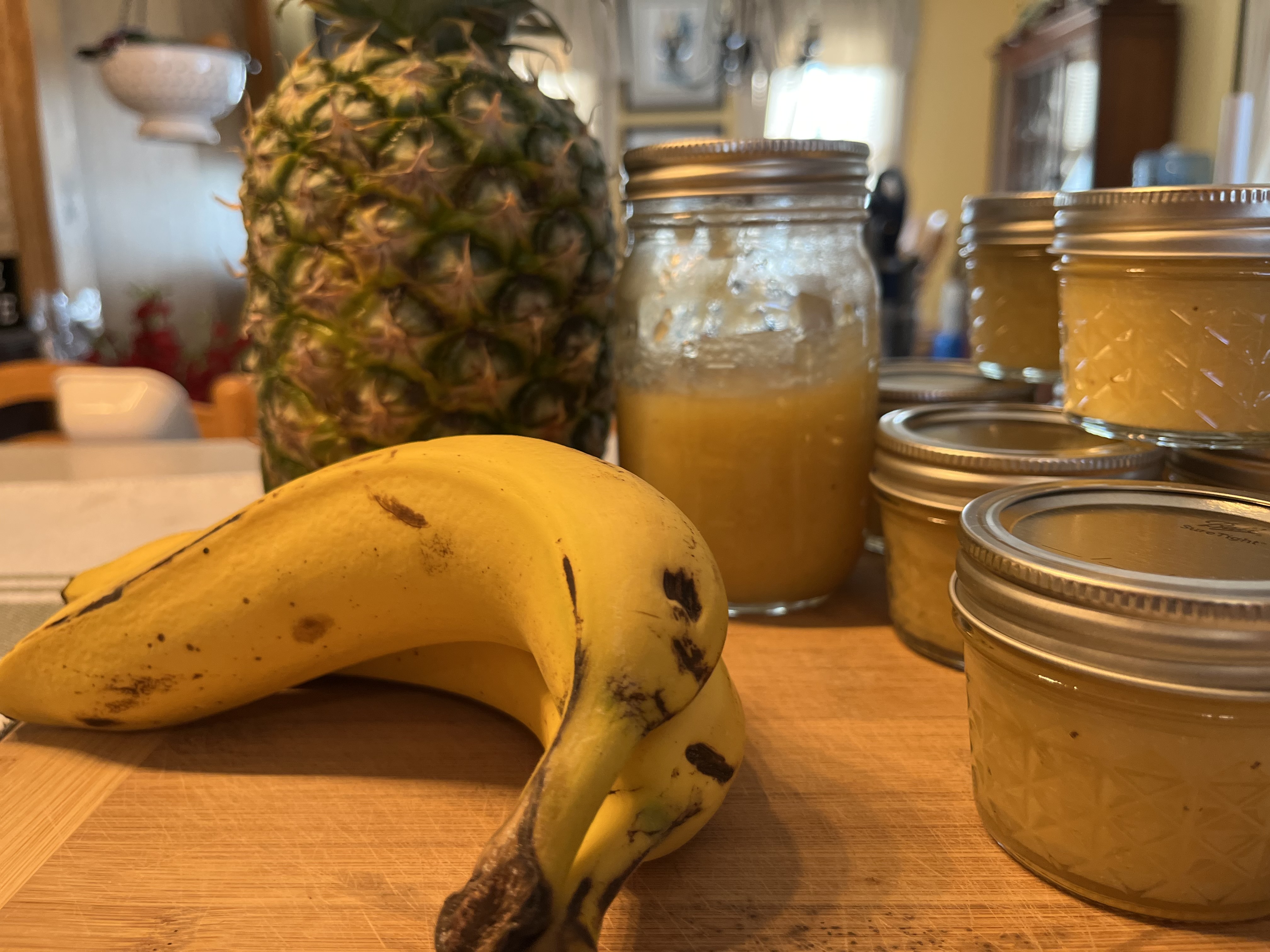

Are you ready to try something so delicious and addicting you’re going to find yourself not only using it on different foods, but you’re also going to find yourself just eating it by the spoonful? Monkey Butter…. a concoction of deliciously sweet bananas, crushed pineapple and coconut, which is actually an optional ingredient in my home. I like to add a little coconut extract instead as I am not a fan of the texture of coconut, and neither is my family.
One of the most appealing parts of Monkey Butter is how versatile of an ingredient it is. It’s absolutely delicious on a biscuit, toast, pancakes, waffles… or simply straight out of the jar. I’ve even enjoyed it with peanut butter in a sandwich. But be forewarned now… I’m not kidding when I tell you this is quite addicting and will soon become a staple in your family’s canning pantry as it is in mine. It’s like food crack and I’m A-OK with that.
Canning can be an intimidating process, especially if you have never canned before. But it’s a process that actually isn’t as scary and intimidating as it appears to be. People have been canning for hundreds of years. The preservation of food especially during the early times before electricity and refrigeration were invented was an absolute must to ensure enough food for a family during the colder months when growing and harvesting isn’t an option. Since those early days of food preservation, standards have been applied to ensure safe canning practices. When those standards are followed you can ensure that you have safely canned something for storage and consumption at a later date. My canned items are stored in my basement and kept in the dark and on shelves for easy access. When canned properly, they can be stored for years and taste as fresh and delicious as they would if you ate them the day they were canned.
There are two types of canning practices: Water Bath Canning and Pressure Canning. Water Bath Canning is great for fruits, tomatoes, salsas, pickles, relishes jams and jellies. These types of foods have a high acid content with a low pH content making Water Bath Canning safe for these items. Pressure Canning is a method of canning foods that are prone to harboring harmful microorganisms such as meats, vegetables, soups and stews. Pressure Canners heat the contents of the mason jars much hotter than a Water Bath canner can accomplish. This ensures that any microorganisms are killed off and the final product is not only shelf stable but safe for consumption. A Water Bath Canner is usually just a very large, enameled pot with a lid and a metal basket inside to keep the jars from touching the bottom. Water is added to completely cover the mason jars being used by about 3″ of water which is kept at a rolling, steady boil throughout the cooking process. A Pressure Canner is a large pot that has a lid with a gasket that actually locks into place. There are valves and gauges used to cook with. Pressure is built up and maintained using these gauges and valves. The canners themselves have come such a long way from where they were. They are very safe now and quite easy to use. You just need to do a little research before using one. You would need to know your elevation for proper use of a Pressure Canner as cooking times vary depending upon your geographical location.
If you have never canned anything before, I suggest you start with the water bath method. It’s much easier, less intimidating and a great way to build up your confidence for canning. I also suggest you get yourself a reputable canning book. There are several to choose from. Ball is a great authority on the subject. You can view a couple of my favorites here and here. At the very least I suggest you watch some informative videos on canning to help you along.
You can go to my channel and view my canning tutorials if you’d like. Since monkey butter uses fruit as the ingredients, we will be using the Water Bath method for processing and it’s as easy as can be.
Combine all ingredients and bring to a boil.


Decide on the consistency you’d like your Monkey Butter to be: Smooth or chunky. This will decide whether or not you use a manual potato masher or an emulsion blender. The emulsion blender will leave a smooth, consistent texture which I personally find much more appealing. It’s simply a matter of personal preference


Cook until thickened and then remove from the heat.
Place in half-pint mason jars and process in a Water Bath for 10 minutes. 15 minutes if you are using pint size jars, but I find the half pint sizes to be the best size. I have included the printable recipe below for you. I hope you will give this a try, whether you’re a beginner or an expert… it’s Monkey Butter for the win!! You can view my video on making Monkey Butter by clicking here. And if you do not have the ability to can or the desire to, this recipe can be made a put in the refrigerator or the freezer as well. I have found however that once your family tastes this deliciousness, it’s best to keep it on a shelf ready to go… even if it’s only for you!
Monkey Butter
[recipe title = "Monkey Butter" Yields = "10 1/2 Pints" Time = "30 Minutes" Difficulty = "Easy Peasy"]

- 5 Ripe Bananas, Remove any brown spots
- 1 20 oz. Can Crushed Pineapple, Juice included
- 2 3/4 c. White Sugar
- 1/4 c. Lemon Juice
- 1/4 c. Shredded Coconut *You can use coconut extract instead if you’d like. You only need 1/8 tsp. You can even omit this all together and the Monkey Butter is still positively delicious.
- 9 1/2 Pint Mason Jars with Lids and Rings
Slice the bananas into thin slices and place in a stainless-steel pan with the crushed pineapple, juice included, the sugar, lemon juice and the coconut if you’re adding that in whatever form. Bring to a boil over medium high heat. Once it boils, decide on the consistency you’d like the final form to be. If you want a completely smooth texture, blend the contents using an emulsion blender. If you want a chunkier, natural texture use a handheld potato masher. Once you achieve the consistency you want, reduce the flame to medium low and cook the ingredients down until they thicken. When the mixture coats the back of a spoon it’s done.
At this point you can store your Monkey Butter in airtight container(s) in the refrigerator for up to 10 days, or the freezer for up to 3 months. You can also “put it up” using a water bath method. For Canning: Use your clean, hot jars and fill with the Monkey Butter leaving a 1/4″ headspace. Once you have all the jars filled, use white vinegar on a paper towel and go around the rims of the jars to remove any sugars or substances that may hinder the sealing process. Next apply your clean lids and rims. Twist the rims on finger tight. Dump the remaining vinegar into your water bath water and place the sealed jars inside the boiling water. Process for 10 minutes at a rolling boil, taking care to make sure the water level remains 2-3″ above the jars. Remove when done and place them in a spot to cool and set for at least 12 hours undisturbed. Remove the collars and check your seals. Anything that didn’t seal you can use up and keep in your fridge. All the rest can go onto your storage shelves to enjoy whenever your family wants.
*Side Note: I find that Monkey Butter can be used on many different things, and it can also be used IN many different things. It adds another level to cakes, cookies and brownies as well as pancakes, French toast and waffles. Think outside the box and enjoy Monkey Butter in a multitude of ways. Drop me a comment below and let me know your favorite way to use and enjoy Monkey Butter!
[/recipe]


Leave a Reply